Court
OC Superior Court · Dept. C61
A single bank instrument frames the question at the center of the non-payment case: the disputed July rent, paid a second time by cashier’s check — made payable not to the landlord alone, but jointly to the landlord and his litigation counsel, and then deposited to counsel’s law-office account.
Allegation framing throughout · Every party is presumed to have acted lawfully until a court or agency finds otherwise · No finding has been made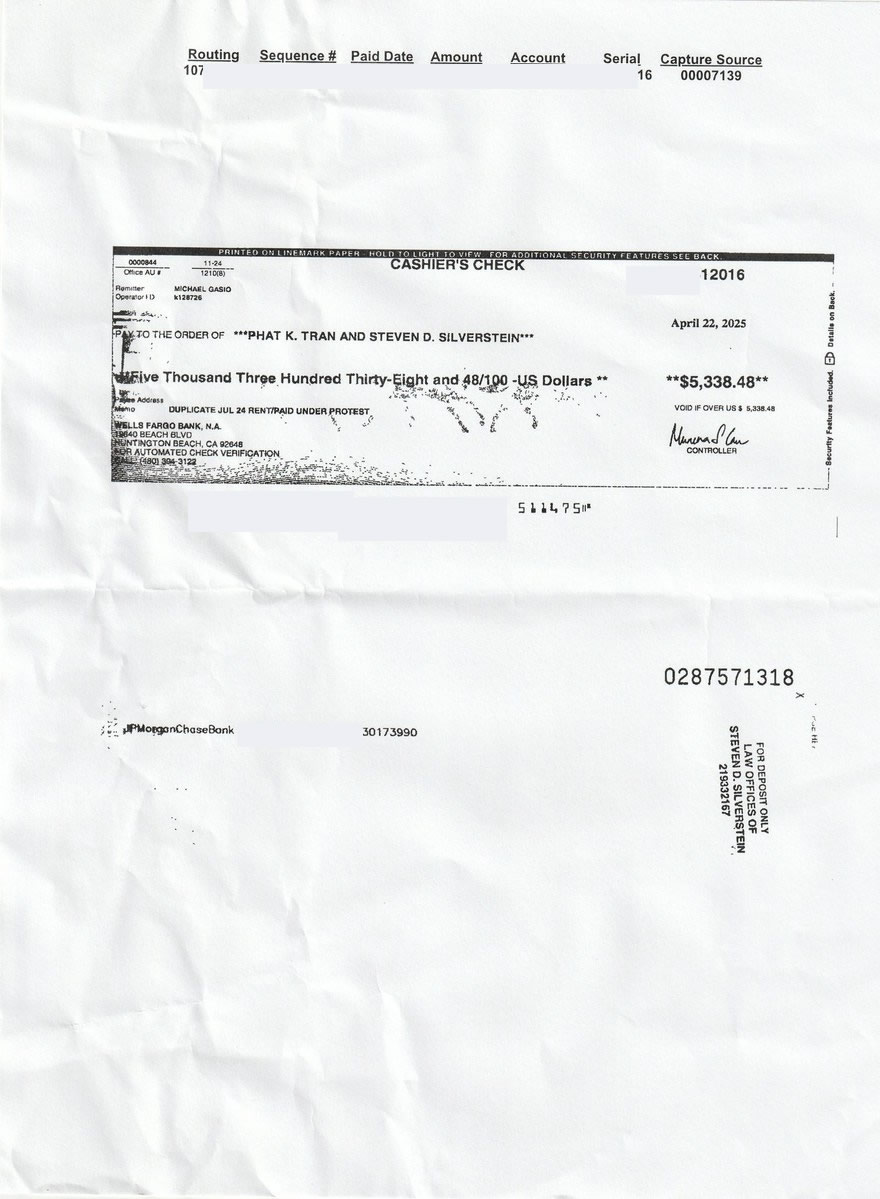
When the disputed rent is paid by a bank-guaranteed cashier’s check; when that check is made payable to the landlord and his litigation counsel jointly; when it is deposited to counsel’s law-office account without the landlord’s endorsement; and when the same sum was the subject of a non-payment action — was the obligation discharged when the instrument was taken, who was required to endorse it, and may a landlord whose agent received and deposited the money be heard, through that agent, to call the rent unpaid?
A cashier’s check is the issuing bank’s own guaranteed obligation — the practical equivalent of cash. California Commercial Code section 3310, subdivision (a), provides that when a cashier’s check is taken for an obligation, the obligation is discharged to the same extent as if that amount of money had been paid. On that rule, the rent obligation was discharged when the instrument was taken; what a payee did or did not do with it afterward does not revive the debt against the remitter.
The check is payable to two persons joined by “and,” not in the alternative. California Commercial Code section 3110, subdivision (d), provides that an instrument payable to two or more persons not alternatively is payable to all of them and may be negotiated, discharged, or enforced only by all of them — both named payees must endorse to negotiate it. On the face of this record the instrument was deposited to one payee’s law-office account; whether the other payee endorsed it, and by what authority a two-name instrument was negotiated, are documentary questions the bank’s own records answer.
Counsel acting for the landlord acts as the landlord’s agent. California Civil Code section 2330 provides that an agent represents the principal for all purposes within the scope of his authority, and section 2332 imputes the agent’s receipt and knowledge to the principal. Money received and deposited by the landlord’s agent is, in law, received by the landlord. The landlord and his agent are not two parties for taking the money and one party for denying it — the question this exhibit presents is whether they may be treated as a single party for both.
A non-payment action turns on a fact within the landlord’s own knowledge: whether the rent was received. That fact is verified, under oath, by the party — not supplied by his retained advocate. The instrument above, made payable to the landlord and that advocate jointly and deposited to the advocate’s account, is the documentary reason the distinction matters here. Who received the money, and whether it was received at all, are questions the landlord answers from personal knowledge; they are not answered by counsel’s argument. No finding has been made.
This page is a documentary record published by Michael A. Gasio, the remitter of the instrument shown and plaintiff pro se in the referenced matter. It is not a brief, a complaint, or an advocacy document, and it is not legal advice; the plaintiff is not an attorney. It describes one instrument in the record and the legal questions its face presents, measured against the statutes named. Attorney advocacy is shielded by the litigation privilege absent knowledge of falsity. No statement on this page asserts that any individual has committed a crime, violated a statute, or breached a duty; every party is presumed to have acted lawfully until a court or agency finds otherwise. No finding has been made by any court or agency as to any matter discussed on this page.
This page reproduces one negotiable instrument — a cashier’s check of which Michael A. Gasio was the remitter — and states the California statutes that govern it, applied as questions to its face. Account, routing, sequence, and MICR numbers and the bank officer’s signature are redacted; the instrument is otherwise unaltered. The plaintiff is not an attorney; nothing here is legal advice, and the authorities cited should be confirmed against the official reporters before any filing or referral relies upon them. No statement should be read as a determination that any person or entity has committed a crime, violated a statute, or breached a duty; attorney advocacy is shielded by the litigation privilege absent knowledge of falsity, and every party is presumed to have acted lawfully until a court or agency finds otherwise. No finding has been made by any court or agency. Cal. Evid. Code §913 — no adverse inference is to be drawn from any party’s silence. Published in the exercise of rights protected by the First Amendment, Article I, Section 2 of the California Constitution, California Civil Code §47(d), and the Noerr-Pennington doctrine.